New review paper on AI for droughts
The eiLab contributed to a systematic review assessing how machine learning has been used in drought research over the past two decades. Published in Water Resources Research, the review analyses 544 scientific papers on machine learning for drought science, focusing not only on which methods are used, but also on how the field is evolving, where research is concentrated, and which gaps still limit its scientific and societal impact.
Key findings include:
- The field has grown rapidly since 2013, with forecasting and monitoring studies dominating the literature.
- Impact assessment and explainable artificial intelligence remain underexplored, despite their importance for drought risk management and stakeholder trust.
- Several drought-prone regions, especially in Africa and South America, remain under-studied in the literature.
- Many studies still rely on small datasets and relatively simple algorithms, limiting the uptake of recent advances in machine learning.
- Reproducibility is a major challenge, with most papers not providing publicly available code.
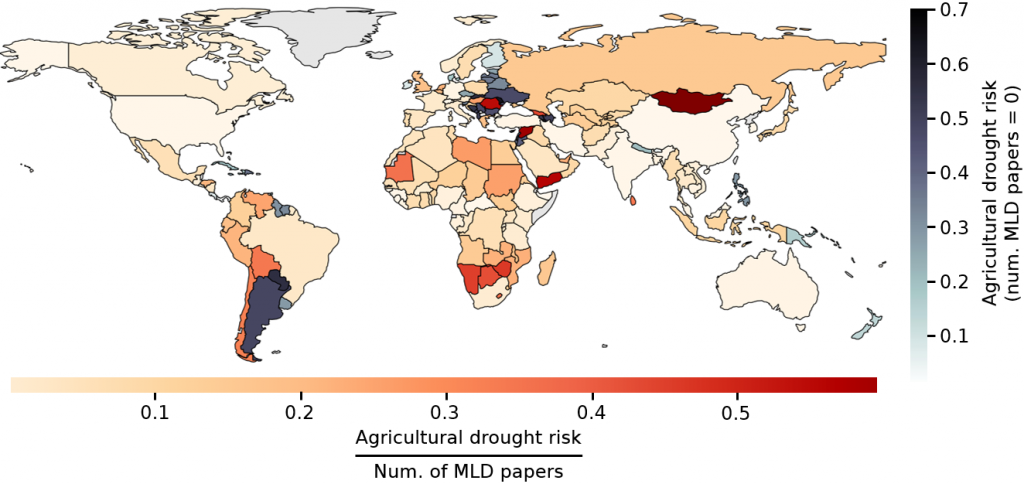
The study highlights the need for broader geographic coverage, greater attention to drought impacts and explainability, larger and more standardized datasets, and more open research practices. Addressing these priorities will be essential for making machine learning a more reliable and useful tool for drought risk management and climate adaptation.
The paper is available here: https://agupubs.onlinelibrary.wiley.com/doi/full/10.1029/2025WR041828