New paper out: A Deep Learning Framework for Extreme Storm Surge Modeling Under Future Climate Scenarios
Sea-level rise is increasing coastal flood risk, with storm surges playing a critical yet highly uncertain role. While physics-based hydrodynamic models remain the reference for simulating these processes, their computational cost limits their use for large ensembles and long term scenario analysis. In the study published in Earth’s Future, the authors investigate whether deep learning can act as a reliable surrogate for storm surge modeling under both historical and future climate conditions. The study develops a neural network emulator of the Global Tide and Surge Model (GTSM), trained on reanalysis data and high-resolution climate projections (CMIP6 HighResMIP), and applied to the New York City coastline as a representative high-risk case. A central limitation of existing AI approaches is their tendency to underestimate rare, high-impact extremes. To address this limitation, this study introduces a novel asymmetric loss function combining quantile and expectile losses, explicitly designed to improve the representation of the upper tail of storm surge distributions.
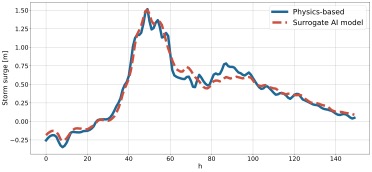
Results show that this approach significantly reduces bias in extreme return levels, while preserving overall predictive accuracy. The proposed surrogate model reproduces the dynamics of the hydrodynamic model with high fidelity, including under future climate forcing. When fine-tuned using climate model simulations, it maintains robust performance across scenarios, closely matching projected changes in return periods and extreme water levels. These results support a complementary modeling strategy. Physics-based models remain essential to represent underlying processes and to generate training and test data, while AI-based surrogates enable scalability and flexibility. Their integration provides a practical framework for advancing coastal risk assessment under deep uncertainty.
The paper is available here: https://doi.org/10.1029/2025EF007072
Data and code availability:
- GTSM data are publicly available from the Climate Data Store (CDS) at: https://doi.org/10.24381/cds.a6d42d60 and can be retrieved using the CDS API.
- ERA5 data are publicly available from the CDS at: https://doi.org/10.24381/cds.e2161bac.
- HighResMIP data can be obtained from the Centre of Environmental Data Analysis archive portal https://data.ceda.ac.uk/badc/cmip6/data/CMIP6/HighResMIP/CMCC/CMCC-CM2-VHR4/highresSST-future/r1i1p1f1/6hrPlevPt.
- The software and analysis scripts (Python code) used to develop the surrogate model, and reproduce the results and figures are available at: https://doi.org/10.5281/zenodo.16748613.